
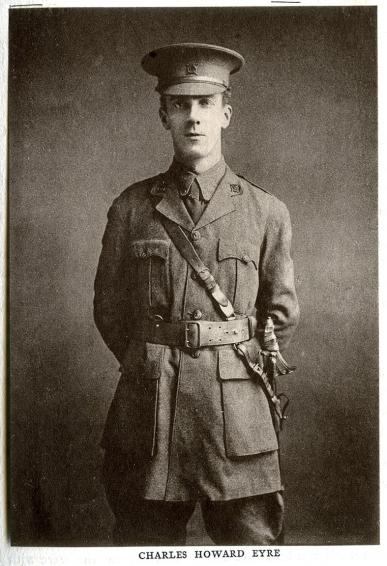
Lt C. H. Eyre - King's Royal Rifle Corps
Youngest son of the late Archdeacon of Sheffield and Mrs Eyre. Entrance Scholar: Monitor 1900; Head of School 1901; Cricket XI 1900-1-2, Captain 1902; Football XI 1901; winner Ebrington Racket Cup 1901; Fives Player 1902; Scholar of Pembroke College, Cambridge; Bell University Scholar 1903; B.A. 1905; M.A. 1910; University Cricket XI 1904-5-6, Captain 1906; Assistant Master at Harrow1906; Hon. Secretary of the Harrow Association.
Lieutenant Eyre joined the King's Royal Rifle Corps, in company with his friend Ronald Lagden, soon after the War broke out. For some time they were at Sheerness together, with other Harrow friends, among them Charles Werner. Lieutenant Eyre went to France in the beginning of December 1914, to find himself at once in the thick of trench work close up to the enemy - one point of the trenches held by us at this time being only ten yards from the Germans - but he was not to see any active fighting in his neighbourhood for a long time. Plainly Harrow was constantly in his thoughts: thus in March 1915, when he was daily expecting to go into action he wrote: "I see you still have strikes. That on top of Russian reverses is rather depressing to read. But as long as no one in England talks about peace till we have won - really won - all is well. The next generations must be spared the horrors of modern war..... Make the boys realise what a big thing we are in for."
In the last letter he wrote to Harrow, on September 19th 1915, he says: "I shall be thinking of you all rallying on the Old Hill this week. I have tried to do my best for it according to my lights ..... I shall be proud and happy to be among 'the Old Harrovians who fell in the Great War." Six days later, on September 25th 1915, leading his Company of the 2nd K.R.R.C. he was the first to reach the enemy's barbed wire and was there shot through the head.
Lieut-Colonel Priaulx wrote:- "It was with great pleasure that I gave him the command of D Company, a few days before the attack. We had a very difficult job, as the wire in our sections was not cut by our shells. The last time I saw Charles he was leading his Company to the attack. He died, like a true Rifleman, at the head of his men. We were both of us Harrovians."
From 'Harrow Memorials of The Great War' Volume III. 1919.
No comments

Free sample PDF
Get a free sample of the book when you sign up to our email newsletter.
How to buy
Great War Portraits is available to purchase now via this website.
